
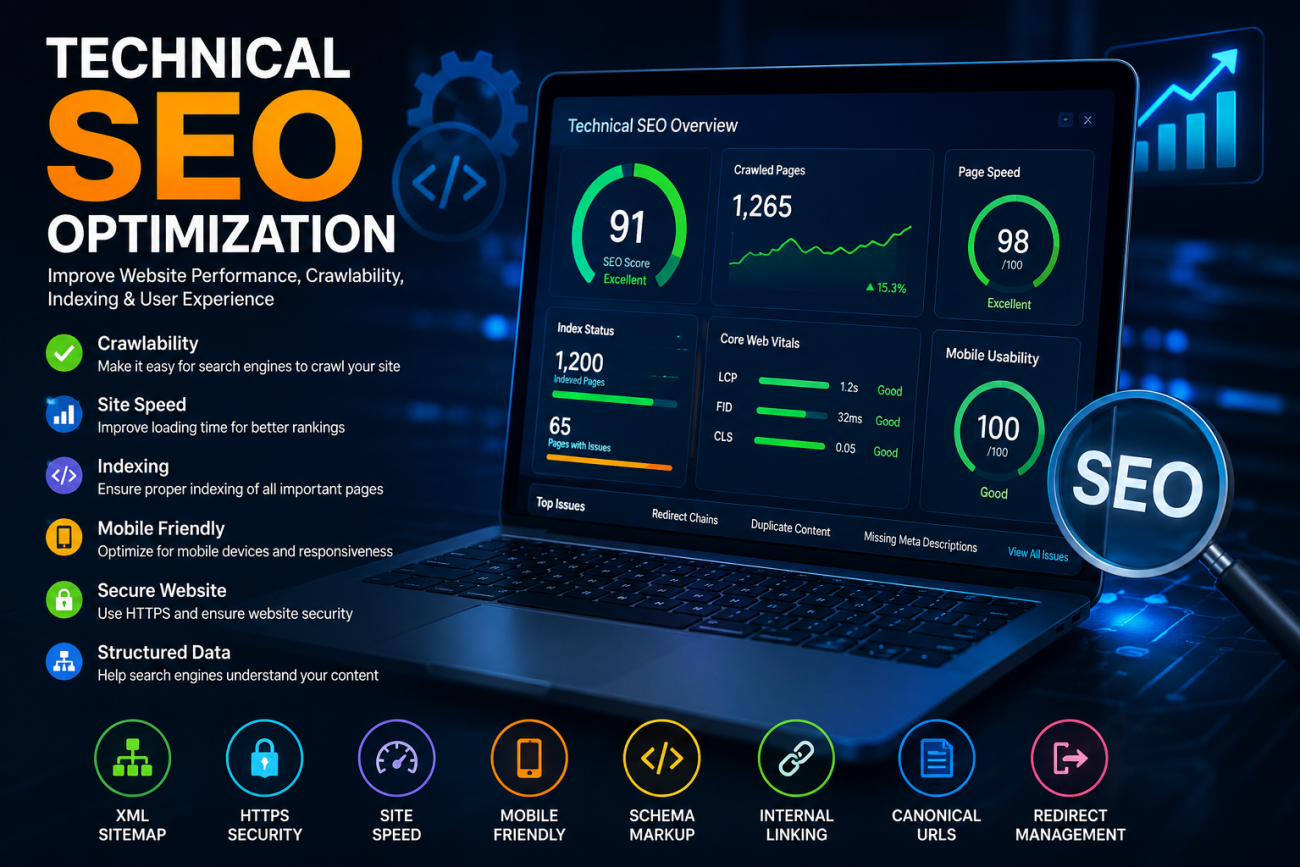
Every business owner in Pakistan wants their website on page one of Google. Yet most sites never get there, and the reason usually has nothing to do with content quality. It comes down to technical SEO optimization. This is the part of SEO that happens behind the curtain. It’s not about the words on your page. It’s about how well search engines can find, read, and trust your site.
Why technical SEO matters so much in Pakistan specifically comes down to one thing: internet conditions here are tougher than in the West. Slower mobile networks, older phones, and data cost sensitivity mean a badly optimized site loses visitors fast. Get the technical side right, and everything else, from content to conversions, works better.
Site Speed and Core Web Vitals
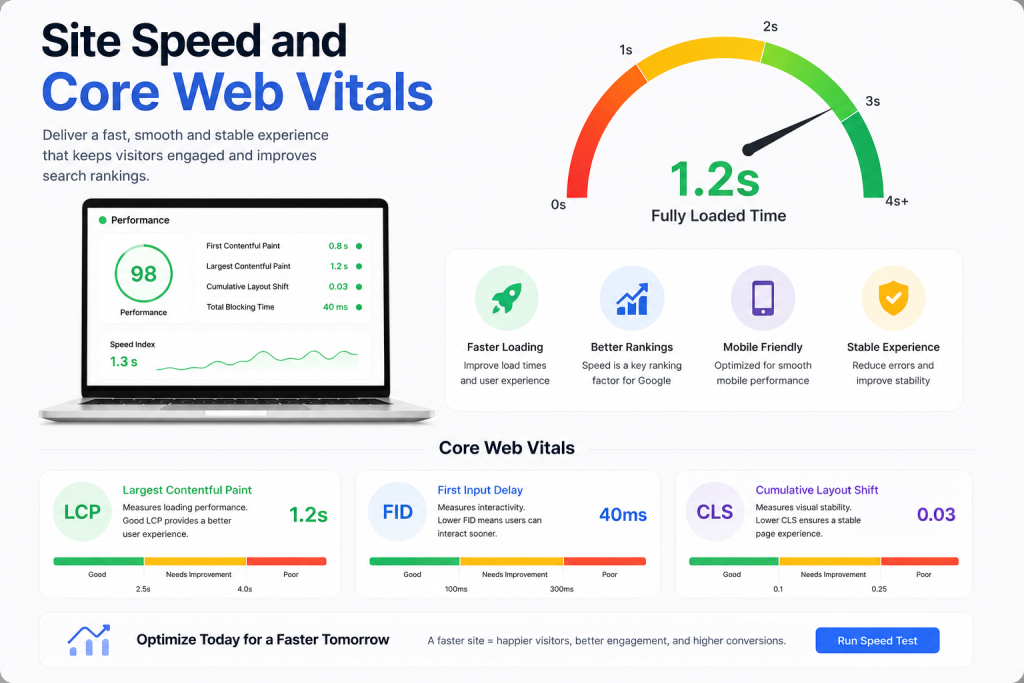
Speed is not a nice-to-have anymore. It is survival. Google has confirmed that page load speed directly affects rankings, and users confirm it too, with their thumbs. A visitor in Lahore browsing on a 4G connection will not wait around for a bloated homepage to finish loading. Research shows that once loading time crosses three seconds, nearly a third of visitors leave. Push past five seconds, and your bounce rate can climb close to 90 percent. That’s not a small leak. That’s a flood.
Core Web Vitals are Google’s official way of measuring this experience. Largest Contentful Paint, or LCP, checks how fast your main content appears. Interaction to Next Paint, or INP, measures how quickly your site responds when someone taps a button. Cumulative Layout Shift, or CLS, tracks whether your page jumps around while loading, which is deeply annoying on a budget smartphone. Improving these three metrics is one of the fastest ways to boost search engine rankings, because Google rewards sites that respect the visitor’s time and data plan.
| Core Web Vital | What It Measures | Good Score |
|---|---|---|
| LCP | Time to load main content | Under 2.5 seconds |
| INP | Responsiveness to interaction | Under 200 milliseconds |
| CLS | Visual stability while loading | Under 0.1 |
Mobile-Friendliness and Responsive Design in Technical SEO Optimization
Pakistan is a mobile-first country in the truest sense, and that’s exactly why technical SEO optimization starts with mobile. Most people never owned a desktop computer before they owned a smartphone. That fact alone should decide how you approach technical SEO for your website. Mobile-friendly design is not optional here. It’s the default expectation, and skipping it undermines every other part of your technical SEO optimization effort. If your menu, your checkout button, or your contact form breaks on a five-inch screen, you have already lost the sale before the customer even saw your product, no matter how solid your technical SEO strategy looks on paper.
Google made this official with mobile first indexing, which means the mobile version of your site is what actually gets evaluated for ranking, not the desktop version. A responsive design adjusts automatically to any screen size, whether it’s a small Android phone in Peshawar or a tablet in an office in Islamabad. Why is my site not mobile-friendly? Usually it’s tiny buttons, text that needs zooming, or images that take forever to load on mobile data. Fixing these issues is one of the cheapest wins in all of SEO, and it pays off immediately.
Website Architecture and Crawlability
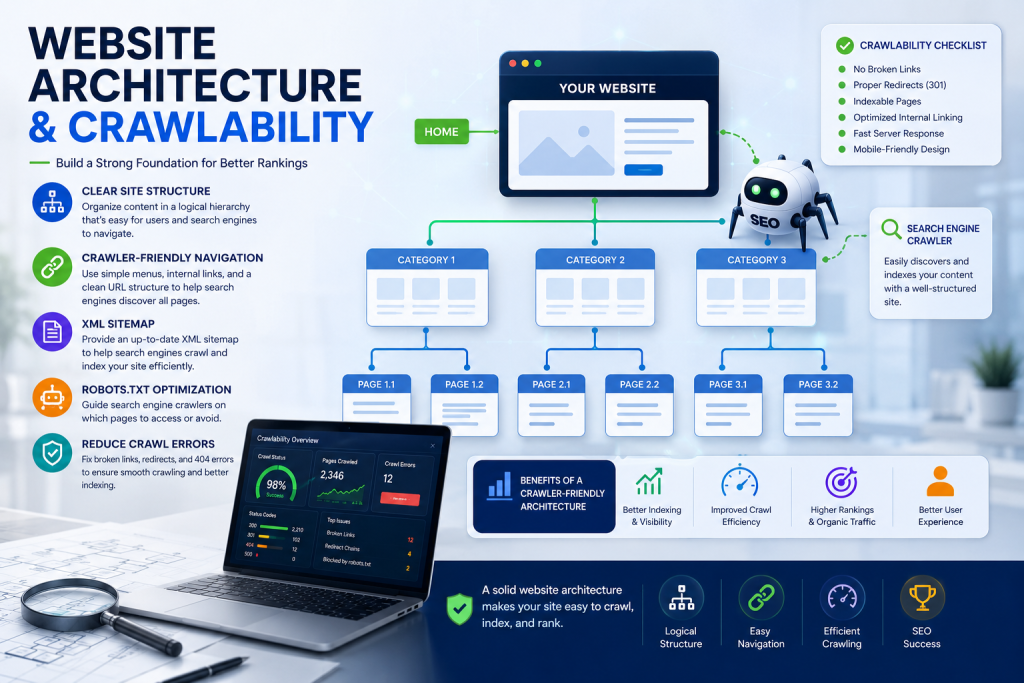
A website needs a logical skeleton, the same way a good building needs a solid frame before the paint goes on. This skeleton is called website structure, and it’s one of the most overlooked pillars of technical SEO optimization. It decides how easily both humans and search engines move around your site. A flat structure, where important pages sit only two or three clicks from the homepage, tends to perform far better than a maze of buried subfolders, which is exactly why technical SEO experts treat site architecture as a priority, not an afterthought.
Crawlability is the technical word for how easily Google’s bots can travel through your pages. Search engine crawlers don’t have unlimited time on any single website. They work within a limited allowance known as crawl budget, and if that budget gets wasted on broken links or duplicate pages, your best content might never get indexed. Clean internal linking, where related pages link naturally to each other, helps crawlers find everything that matters. It also helps real visitors, which is exactly what Google wants to see.
Robots.txt in Technical SEO Optimization: Controlling What Search Engines Crawl
What is a robots.txt file used for? It’s a small text file sitting quietly at the root of your domain, and it tells search engines exactly where they are allowed to go. Think of it as a guard standing at the gate of your website, checking IDs before letting anyone through. Without it, crawlers wander in blindly, sometimes wasting time on pages you never wanted indexed in the first place.
How does robots.txt work? It uses simple rules to allow or block specific folders and pages, and getting this right is a core part of technical SEO optimization. A poorly written robots.txt file can accidentally block your entire site from Google, which happens more often than you’d think, especially after a website migration. A well-configured one, on the other hand, reflects solid technical SEO practice, protecting sensitive areas like admin panels while directing crawlers straight to your money pages. Getting this file right takes ten minutes. Getting it wrong can cost you months of lost traffic, undoing every other bit of technical SEO optimization work you’ve done.
XML Sitemaps: Guiding Search Engines to Your Best Content
What is an XML sitemap? It’s essentially a directory of every important page on your website, handed straight to Google in a format it can read instantly, and this small file plays a bigger role in technical SEO optimization than most people realize. Instead of hoping crawlers stumble across your newest blog posts or product pages on their own, you’re handing them a map with all the good spots marked, which is exactly the kind of groundwork solid technical SEO depends on. Skipping this step is one of the most common technical SEO mistakes Pakistani websites make, and fixing it is one of the easiest wins in technical SEO optimization.
Why do I need a sitemap for SEO? Because discovery speed matters. A new landing page without a sitemap entry might take weeks to get noticed. With one, it can get crawled within hours. Submitting your XML sitemap through Google Search Console is free and takes minutes, yet a surprising number of Pakistani business websites skip this step entirely. Keeping the sitemap updated as you add or remove pages is just as important as creating it in the first place.
Canonicalization and Duplicate Content Management
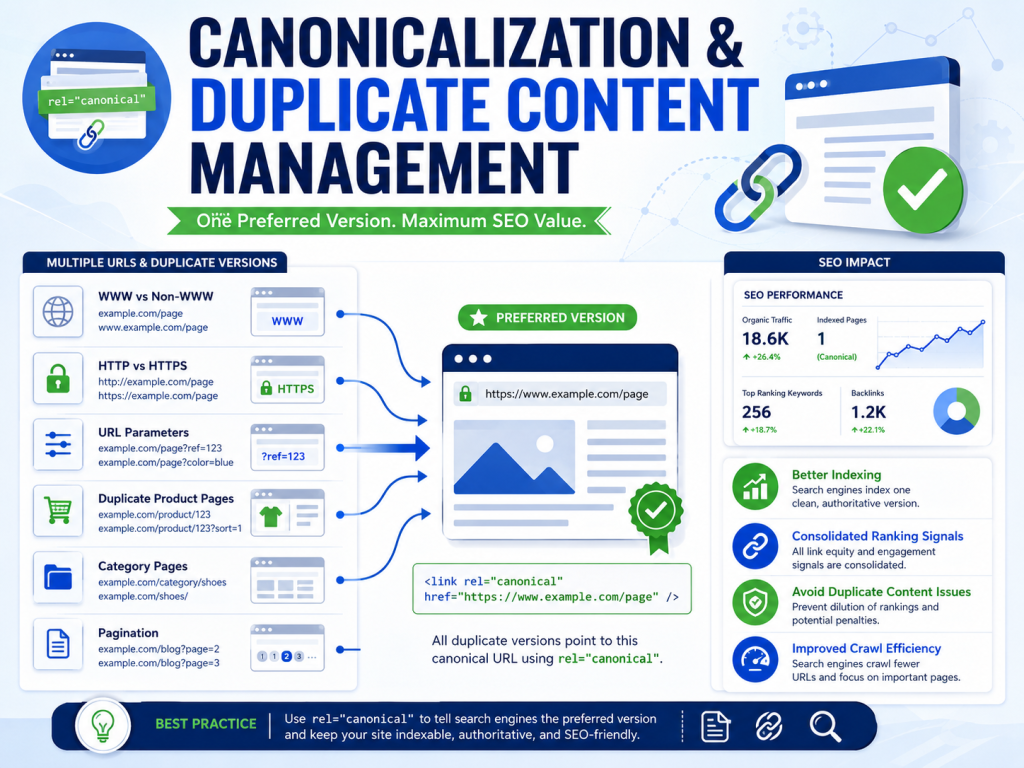
What is canonicalization in SEO? It’s the process of telling Google which version of a page is the real one when multiple URLs show the same or very similar content. This happens more often than site owners realize, especially on e-commerce stores where the same product appears under several categories.
Duplicate content confuses search engines and dilutes your ranking power across multiple duplicate URLs instead of concentrating it on one strong page. How to fix duplicate content issues? You use canonical tags, written with the rel=”canonical” attribute, to point every duplicate back to the master copy/URL. This single line of code prevents content clones from splitting your SEO strength. What is Google’s Panda algorithm? It was Google’s early defense against thin and duplicate content, and its legacy still shapes how the modern algorithm evaluates originality today. Proper canonicalization protects your site from being penalized under these same principles.
HTTPS, Security, and Structured Data (Schema Markup)
Security is no longer just an IT concern. It’s an SEO factor. Google has publicly confirmed that HTTPS, the padlock icon in your browser bar, is a ranking signal. Beyond rankings, it builds trust, which matters even more in Pakistan where online payment fraud concerns still make many shoppers cautious. A site without HTTPS actively scares away potential customers before they even browse a single product.
Structured data, commonly called schema markup, is the other half of this puzzle. It’s a special code layer that helps search engines understand exactly what your content means, not just what it says. Adding schema to a recipe page can make ratings and cook times appear directly in search results. Adding it to a business listing can surface your address and hours right on the search page. This kind of visibility pulls attention away from competitors and straight to you, often before the visitor has even clicked a single link.
Fixing Crawl Errors and Broken Links (404s, Redirects)
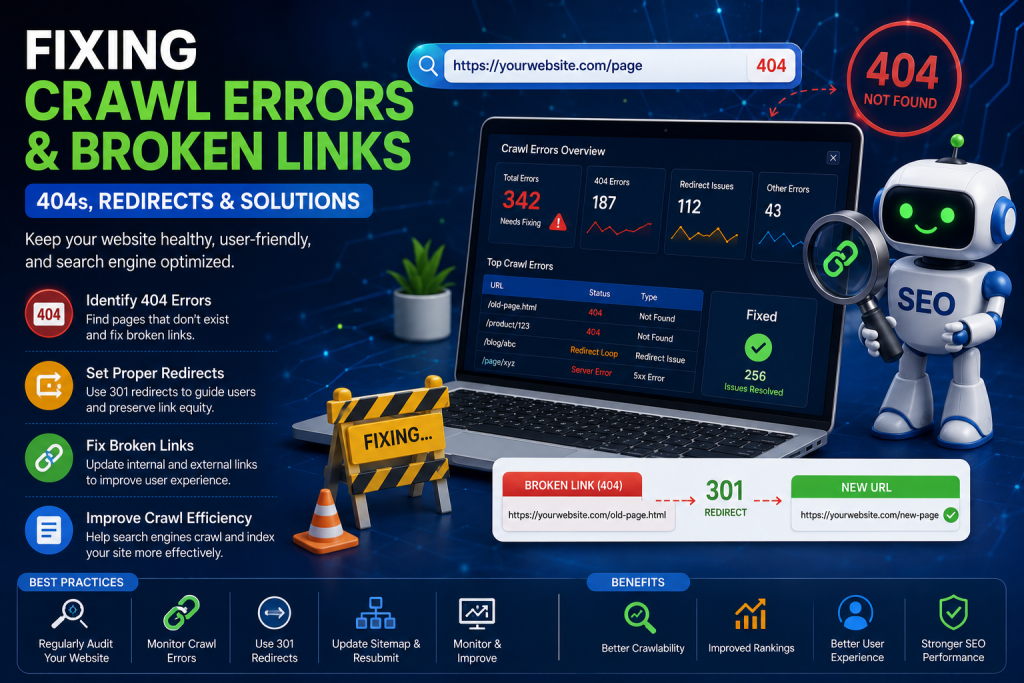
Every website accumulates broken links over time. Products get discontinued, pages get renamed, and old URLs stop working. These become 404 errors, and while a few won’t sink your rankings, a pile of them signals neglect to both users and search engines. Regularly checking Google Search Console for crawl errors is a habit every Pakistani business should build into their monthly routine.
Redirects fix this problem when handled correctly. A 301 redirect tells search engines a page has permanently moved, passing along its ranking value to the new address. A 302 redirect signals a temporary move and should be used sparingly. Mixing these up, or worse, creating long redirect chains where one URL bounces through five others before landing anywhere useful, wastes server resources and confuses crawlers. Clean redirect management keeps your website audit results healthy and your organic traffic steady.
Technical SEO Checklist: Key Takeaways
Getting technical SEO optimization right is not a one-time task. It’s ongoing maintenance, much like servicing a car regularly instead of waiting for it to break down on the motorway. The table below summarizes the priorities covered in this guide.
| Technical SEO Area | Why It Matters |
|---|---|
| Site speed and Core Web Vitals | Reduces bounce rate, improves user experience |
| Mobile-friendliness | Matches Pakistan’s mobile-first browsing habits |
| Crawlability and structure | Helps search engine crawlers find your best content |
| Robots.txt | Controls what gets crawled and indexed |
| XML sitemaps | Speeds up discovery of new pages |
| Canonicalization | Prevents duplicate content penalties |
| HTTPS and schema | Builds trust and improves search visibility |
| Crawl error fixes | Preserves link equity and organic traffic |
Clean code, a clear site presentation, and consistent indexing habits form the backbone of every high-ranking website. Pakistani businesses that treat technical SEO as seriously as their content strategy tend to see faster, more lasting gains in search engine rankings.
Frequently Asked Questions (FAQs)
1: How to speed up website loading time?
Compress your images, use a lightweight theme, and consider a content delivery network to serve pages faster to visitors across different cities in Pakistan.
2: How to make a website crawlable?
Keep your site structure shallow, fix broken internal links, and submit a clean sitemap through Google Search Console.
3: What does pogo-sticking mean in SEO?
It’s when a visitor clicks your result, dislikes what they see, and immediately returns to the search page. Google treats frequent pogo-sticking as a sign of poor relevance.
4: How to get a free website audit?
Many SEO agencies in Pakistan, including local digital marketing firms, offer no-cost audits that scan for speed issues, duplicate content, and mobile usability problems.
5: Why is my website not ranking on Google?
Usually it’s a mix of slow loading time, poor mobile experience, weak internal linking, or missing technical basics like sitemaps and canonical tags.
Related Links :
https://webhelp.pk IT Solutions & Development Technical Support Company
https://infusions.pk Organic Herbal Store
https://gulbergoffice.com Real Estate Company
https://eeshaal.com Travel & Tour Company
